


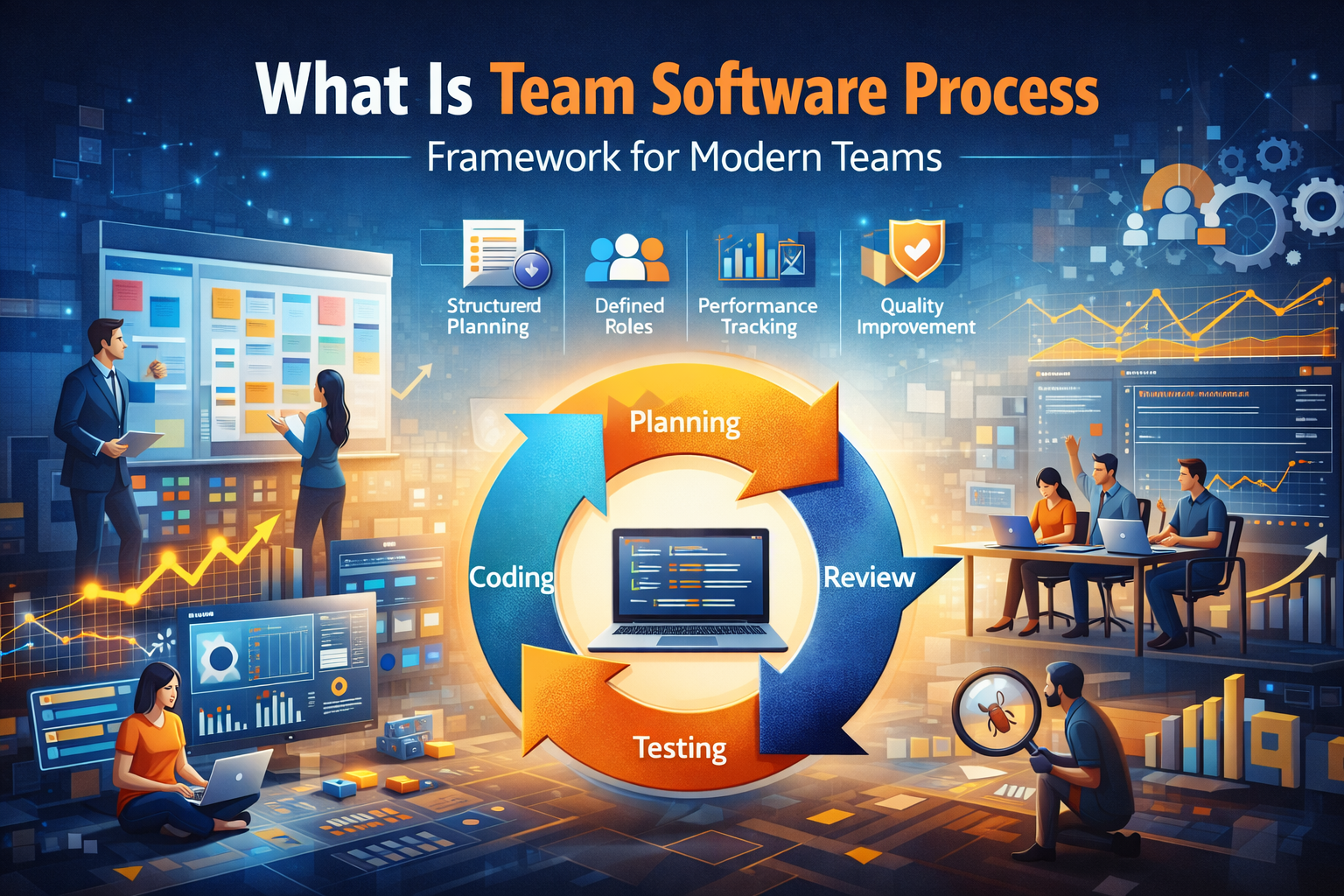
Understanding the meaning of the team software process is crucial for current software teams seeking higher quality, greater predictability, and enhanced collaboration. As development projects become increasingly complex, team-based processes enable organizations to manage requirements, code conventions, testing, and delivery effectively and efficiently.
This step-by-step tutorial explains what a team software process is, how it operates, its advantages, its phases, its comparison with other methodologies, and why it is relevant in the current agile-oriented software business.
What Is the Team Software Process in Software Engineering?
The Team Software Process (TSP) is a formal process that helps development teams plan, manage, and organize software projects. It is based on disciplined engineering activities and is aimed at enhancing quality, productivity, and working togetherness at all levels of development.
Speaking about what a team software process is, one should realize that it focuses on measurable performance, defined roles, and continuous improvement. Customization measures teams using defects, time, and progress to ensure predictable and reliable results.
Core Objectives of Team Software Process
To become more familiar with the concept of team software process, it is better to examine its main objectives. These objectives are directed towards quality, discipline, and teamwork, and not merely speed.
- Defect prevention: improve software quality.
- Design a feasible project planning and schedule.
- Promote team responsibility and ownership.
- Measure performance based on quantifiable data.
- Minimize risks by detecting the risks early.
- Encourage the constant process improvement.
These goals make TSP especially beneficial for companies that handle large or mission-specific projects.
Phases of Team Software Process
TSP is structured into distinct phases. Every stage involves planning, implementation, and evaluation.
Launch Phase
In the launch stage, the team establishes objectives, allocates roles, and develops an elaborate project plan. This stage ensures that each person understands expectations and duties. Teams also estimate work, identify risks, and set quality goals prior to development.
Development Phase
It is in this stage that coding, design, and testing take place. Members of the team monitor time spent, defects detected, and plan progress. Frequent checks and examinations are used to ensure high-quality standards throughout the development lifecycle.
Postmortem Phase
Upon the Project completion, the team evaluates the performance data. They will assess the good stuff and the areas that need improvement.
This is the ongoing learning process on what a team software process is and why it boosts productivity in the long term.
How TSP Compares to Other Software Processes
To explain the meaning of the team software process, it is helpful to compare it with other common processes, such as Agile and Waterfall.
TSP vs Other Methodologies
| Feature | Team Software Process (TSP) | Agile | Waterfall |
| Focus | Quality & measurable data | Flexibility & speed | Sequential phases |
| Planning | Detailed upfront planning | Adaptive planning | Fixed planning |
| Documentation | Structured & data-driven | Lightweight | Heavy documentation |
| Team Roles | Clearly defined roles | Flexible roles | Traditional roles |
| Risk Management | Continuous tracking | Iterative feedback | Late detection |
TSP is different, as it is anchored in extensive measurement and disciplined practices, rather than in sheer flexibility through iterations.
Benefits of Implementing Team Software Process
Knowing what a team software process is also implies awareness of its benefits. Improvements in quality and productivity are usually measurable in organizations that use TSP. To begin with, defect rates are at their lowest level because teams conduct frequent reviews and inspections. Second, the project’s predictability is enhanced by data-based planning.
Third, there is a better comprehension of communication because roles are specified. Fourth, teams also foster confidence by objectively monitoring progress.TSP has a structured documentation process that is particularly advantageous for companies operating in regulated industries.
Key Roles in Team Software Process
TSP establishes certain roles in a development team. There is accountability to each role and an equal distribution of workload.
Some of the common ones are team leader, development manager, quality manager, process manager, and support manager. These jobs are assigned to team members to enhance leadership skills.
TSP limits confusion by clarifying responsibilities and strengthening cooperation throughout the project.
Tools Used in Team Software Process
A number of tools are useful for teams applying TSP. These tools monitor metrics, defects, and task time utilization.
Examples include:
- Defect tracking system
- Time tracking software
- Project planning tools
- Code review platforms
- Dashboards of quality measurement.
These tools ensure teams capture accurate performance data, which is the main focus of the team software process.
Why Metrics Matter in TSP
The emphasis on quantifiable measures is one of TSP’s peculiarities. The teams gather information concerning defects, effort, size, and schedule performance.
Such a quantitative method enables managers to make good decisions rather than basing them on assumptions. It also helps teams become more accurate at estimating over time. The use of data-driven insights makes TSP highly reliable for large-scale enterprise software projects.
What Is Team Software Process and Why It Matters Today
The modern world of competitive software requires delivering high-quality products quickly. Knowledge of what a team software process can enable organizations to achieve a balance between speed and quality.
Agile practices are usually embraced in modern development environments. Nevertheless, discipline and defect prevention can be reinforced with TSP. To get a more detailed overview of structured development models, have a look at our internal reference on software development life cycle phases.
What Is the Team Software Process in Agile Environments?
Numerous practitioners question the place of the team software process in the Agile context. TSP can be used to add Agile with more powerful measurement and quality control.
Agile promotes flexibility, whereas TSP focuses on discipline and monitoring. Integration of the two strategies can establish moderate development conditions.
Common Challenges in Adopting TSP
Despite its strength, TSP implementation would need commitment. Teams might not be willing to track and document in detail.
Training is needed to adapt successfully. The external source is Carnegie Mellon University, which offers learning information on disciplined software engineering practices.
Best Practices for Successful TSP Implementation
Organizations should embrace best practices to maximize TSP benefits. Start with proper training. Establish effective roles and duties. Keep data consistent. Carry out frequent reviews and retrospectives. Stimulate free communication and joint problem-solving. With time, teams gain confidence and become more productive.
Conclusion
Knowledge about what a team software process is useful in helping organizations to develop disciplined, data-driven, and high-performing software teams. TSP is oriented toward quantifiable planning, quality enhancement, role specification, and lifelong learning.
Through organised practices, the teams minimise defects, enhance predictive capabilities, and collaborate. TSP has strong quality control, whether applied alone or in combination with Agile. If your organization needs to improve software reliability and productivity, learning more about the team’s software process is a good move.
FAQs
What is the team software process, simply put?
Team Software Process (TSP) is a formal model that helps software teams plan, monitor, and improve their work in development using measurable data and well-defined roles.
Who is the Team Software Process developer?
Team Software Process evolved at Carnegie Mellon University, Software Engineering Institute (SEI) as a method to enhance the software quality and performance of the team members.
What is the difference between TSP and Agile?
TSP is more concerned with planning and role distribution, defining performance, and Agile is more focused on flexibility, fast iterations, and customer feedback.
So what is the importance of measurement in TSP?
Measurement helps teams monitor defects, time, and productivity. This information enhances the accuracy of planning and sustaining the process’s improvement.
Is Team Software Process applicable to small teams?
Yes, small teams can use TSP. It allows them to be organized, stay quality, and reduce variability in the delivery of projects.
